SPACE June 2026 (No. 703)
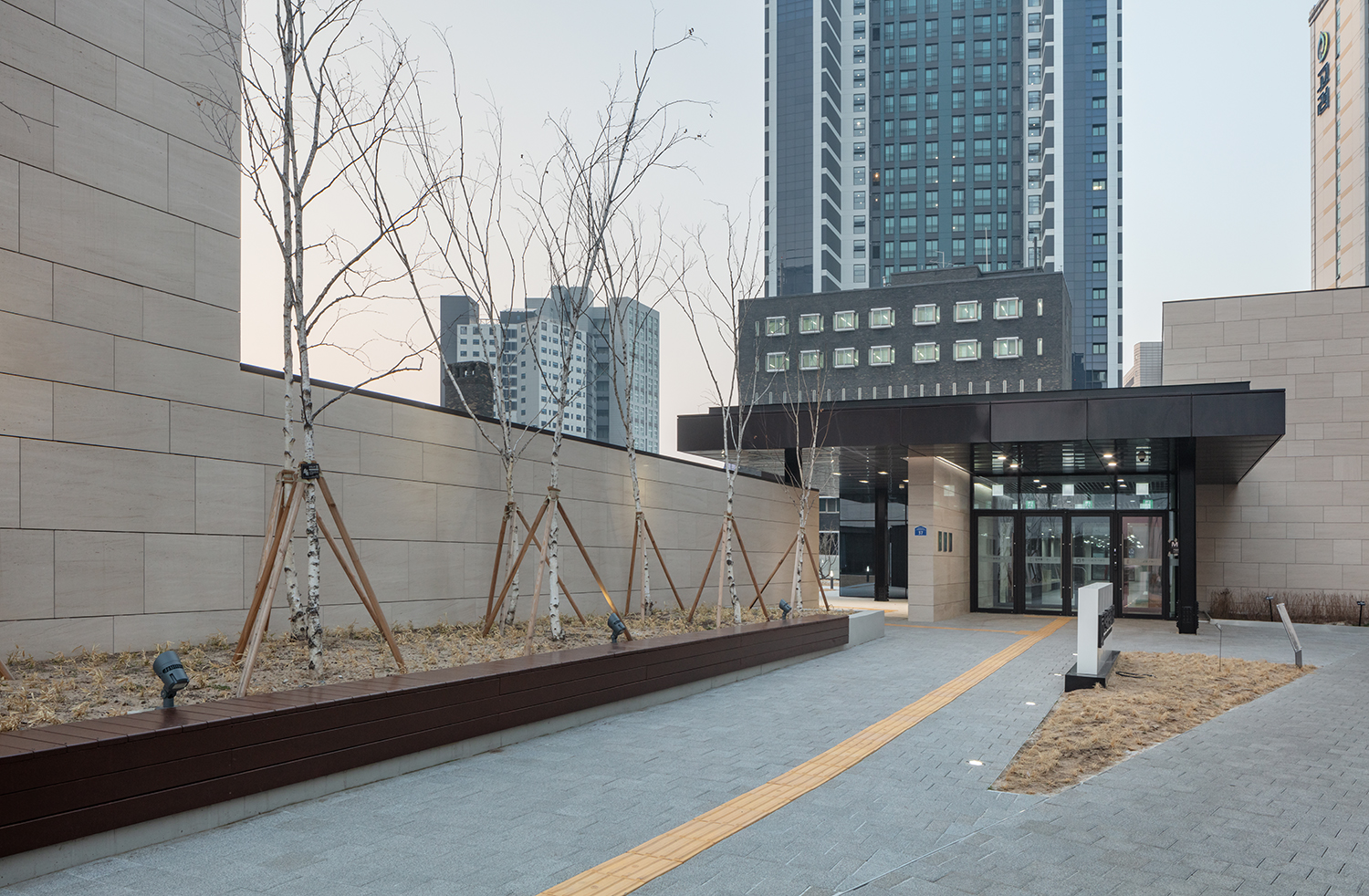
The main entrance to the National Museum of Korean Democracy, which opened in June 2025. The M2 (Former Namyeong-dong Anti-Communist Interrogation Office) can be seen in the background.
interview Kim Sungil Curatorial Affairs Department Director, Korea Democracy Foundation, Kim Youngchul Creative Director of the Opening Exhibition, Korea Democracy Foundation, Chung Hyuna Principal, DIA Architecture × Bang Yukyung
Completed in 1977 and designed by Kim Swoo Geun, the Namyeong-dong Anti-Communist Interrogation Office is a symbolic site that preserves the scars of state violence from the era of military dictatorship. With ancillary facilities such as exhibition halls newly built around the Anti-Communist Interrogation Office, the National Museum of Korean Democracy opened in June 2025. Through the voices of three figures involved in transforming a negative heritage site once cut off from the outside into a public place – an architect, an exhibition director, and an operator – we examine the process of creating a space that commemorates democracy, its role, and its contemporary meaning.
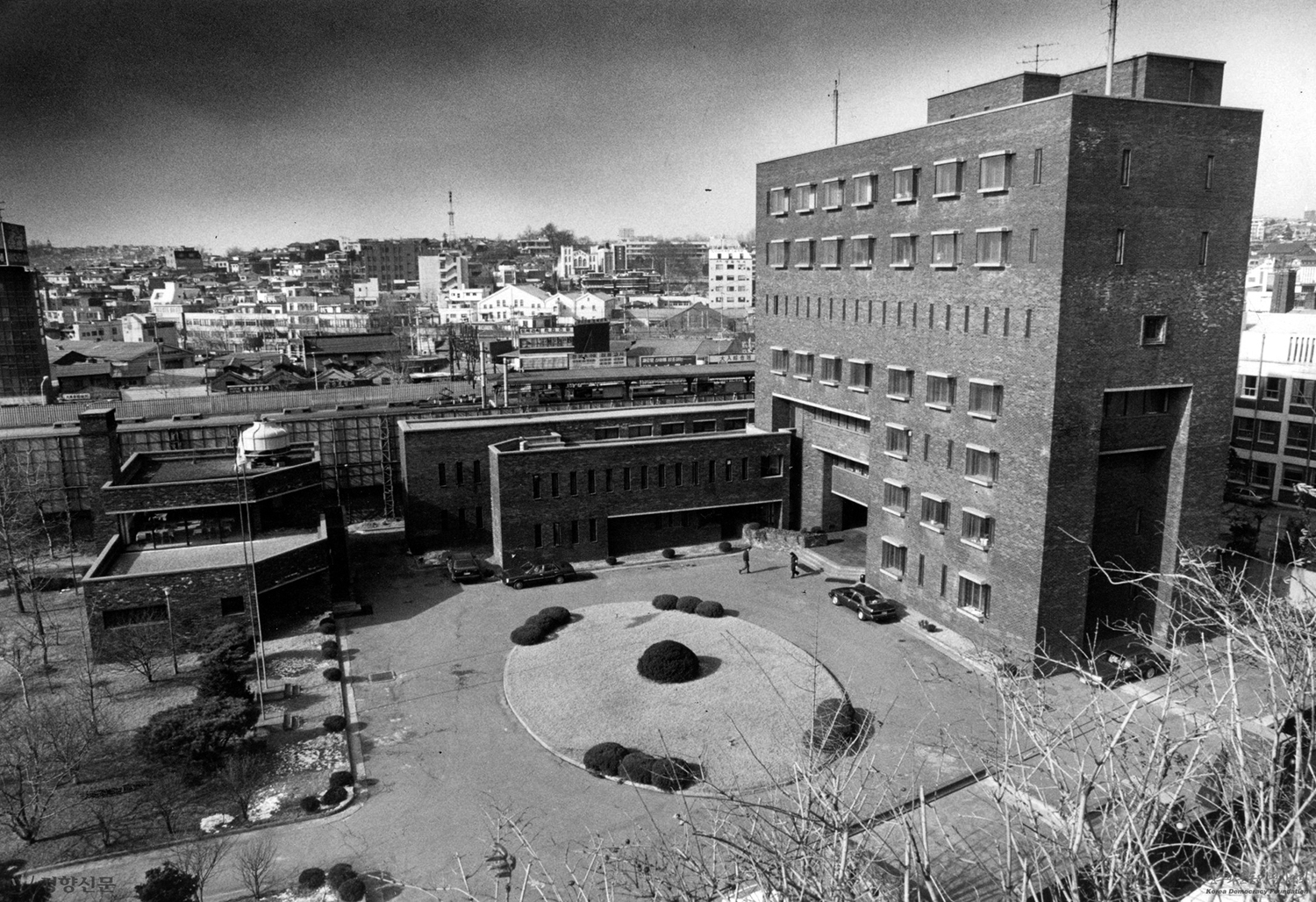
The Namyeong-dong Anti-Communist Interrogation Office, whose design was commenced by Kim Swoo Geun in 1976 and completed in 1977, was originally built with five storeys before being expanded to seven storeys in 1983. Although it operated under cover names such as the International Oceanic Research Institute, it became widely known as the Namyeong-dong Anti-Communist Interrogation Office in 1987 when the Park Jongcheol torture death case was exposed. The fifth-floor investigation rooms, where the atrocities took place, were designed with narrow, elongated windows to prevent detainees from jumping out or escaping. Image courtesy of Korea Democracy Foundation
Bang Yukyung: I heard that there were many twists and turns before the National Museum of Korean Democracy was created around the Namyeong-dong Anti-Communist Interrogation Office (hereinafter the Anti-Communist Interrogation Office). What happened during that period?
Kim Sungil: The Korea Democracy Foundation (hereinafter KDF) is an organisation established under a special law enacted by the National Assembly in 2001 with the purpose of commemorating Korea’s democratisation movement at the national level. Since ‘the construction and operation of the National Museum of Korean Democracy’ was KDF’s first principal project, we promoted the construction of the museum immediately after the organisation was formed. The project, which had drifted for more than 15 years while facing difficulties in selecting a site, entered a new phase when a new government came in after the impeachment of President Park Geun-hye in 2017. The site was confirmed when President Moon Jae-in announced at the 31st Anniversary of the June 10 Democratic Struggle in 2018 that the former Anti-Communist Interrogation Office would be developed into the Democracy and Human Rights Memorial Hall, now the National Museum of Korean Democracy.
Bang Yukyung: For the creation and operation of the museum, an extensive preliminary investigation and public deliberation process was carried out. What was the outcome of this wide-ranging collection of opinions?
Kim Sungil: It can be explained through exhibition, education, and network. Through exhibition, we show the history of the democratisation movement and the sites of anti-human-rights violence committed by the state; through education, we pass on the core values and spirit of the democratisation movement to later generations. These are the two important axes of operation. Since South Korea is almost the only country among those liberated from colonial rule after World War II that developed industrialisation and democratisation simultaneously, a function of internationally publicising this history was also required.
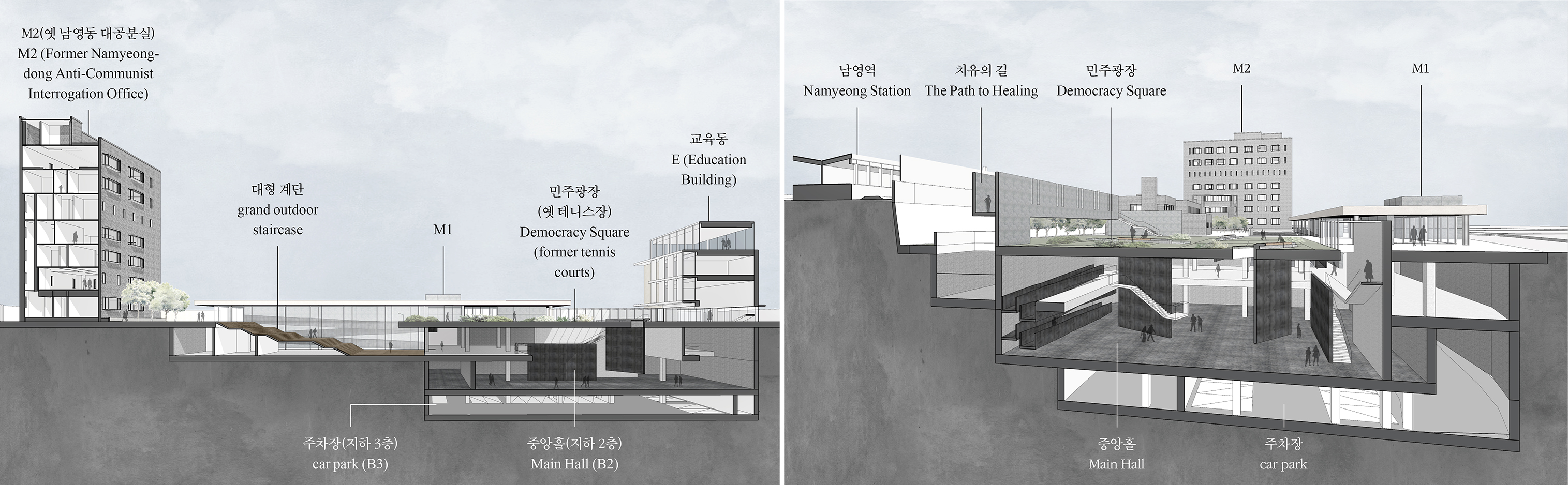
Following the transfer of management and ownership of the Namyeong-dong Anti-Communist Interrogation Office from the National Police Agency to the Ministry of the Interior and Safety in December 2018, a design competition for the construction of the (provisionally named) Democracy and Human Rights Memorial Hall was held in October 2019. In the design competition to create exhibition spaces whilst preserving the Namyeong-dong Anti-Communist Interrogation Office as it stands, The Low Gaze: Facing History by DIA Architecture (Principal, Chung Hyunah) was selected as the winning proposal. As shown in the sectional perspective drawings, a key feature of the design is its active utilisation of the underground space. ©DIA Architecture
Bang Yukyung: After the site was confirmed, what specific steps followed?
Kim Sungil: While holding expert forums involving people from history, architecture, exhibition, and participants in the democratisation movement, as well as a public deliberation forum of 100 people from civil society organisations, we also carried out an investigation into the actual conditions of torture, a basic facility survey, and an oral-history project with related people. In 2019, we also conducted a research service on the museum’s feasibility and the establishment of an operation plan. By organising these contents, we came to hold the design competition in 2019. At the time, civil society, including victims of torture, strongly argued that the Anti-Communist Interrogation Office should be left exactly in its original state, so preservation was agreed upon. There were also opinions that the aboveground tennis court should be preserved in order to plainly show the behaviour of the torture police, who played tennis and enjoyed themselves even while committing harsh acts, and this was partially reflected in the competition guidelines.
Chung Hyuna: The amount of material provided at the time of the competition was vast. In addition to materials on the Anti-Communist Interrogation Office, discussions and consultation contents with related people and civic groups who participated in the process of discussing the construction were also provided. In fact, at first I applied to participate out of interest in both the Anti-Communist Interrogation Office and the architect Kim Swoo Geun, but while examining the materials and proceeding with the design, I realised that the designer’s job was working out how to allow the victims of torture to heal in this place. In reality, the Anti-Communist Interrogation Office building itself was excluded from the design scope, and it was necessary to propose an idea for how to use the tennis courts while securing sufficient exhibition area. Above all, what is special about this competition is that it is a memorial hall built on the actual site, like the World Trade Center or the Holocaust Memorial. Since it is impossible to surpass the solemnity and powerful feelings invoked by the Anti-Communist Interrogation Office, I began the design by focusing on what should be remembered through this site.
Bang Yukyung: The winning proposal, The Low Gaze: Facing History, is characterised by the placement of the newly constructed buildings [currently M1, E (Education Building)], so that it faces the Anti-Communist Interrogation Office (currently M2), and by an overall circulation sequence that gradually descends. Accordingly, most of the exhibition spaces are located underground.
Chung Hyuna: When attending reviews or consultations, I could feel that related people, including victims of torture, and civic groups were extremely sensitive to the site being damaged. Because there was a strong defence mechanism that ‘if it is removed, it will be erased,’ they demanded the preservation not only of the tennis courts but also of the wall, barbed wire, guardhouse, and other elements. In order to satisfy the required area presented in the competition, a large building inevitably had to be introduced, but as I considered the direction of minimising intervention, I naturally came to think of the underground. I proposed the concept that ‘the past and present face each other and converse’ by leaving the traces of the tennis courts to create an exterior space and setting the new buildings back by that distance. Also, because a large space with a high ceiling was needed as an exhibition space, I organised an exhibition circulation that circulates through the entire site and arrives, at the end, at the underground Main Hall, which is the large space. Above all, I saw it as important that this place, closed off by the railway and buildings, become a valuable public space in the city, like a park.
Bang Yukyung: Kim Youngchul, who served as Creative Director of the Opening Exhibition, joined after the design competition ended and after the basic exhibition plan had been established. Were there any difficulties in comprehensively directing the exhibition, media, and promotion?
Kim Youngchul: Since the main content of the exhibition and the architectural space had already been confirmed, I focused on understanding them and turning them into content. Above all, because the feelings aroused by the Anti-Communist Interrogation Office are strong, I focused on preserving the building well and on how people would experience this place. So I proposed the concept of ‘soundscape’, which had not been in the basic exhibition plan. The intention was to ‘design the exhibition space with sound’.
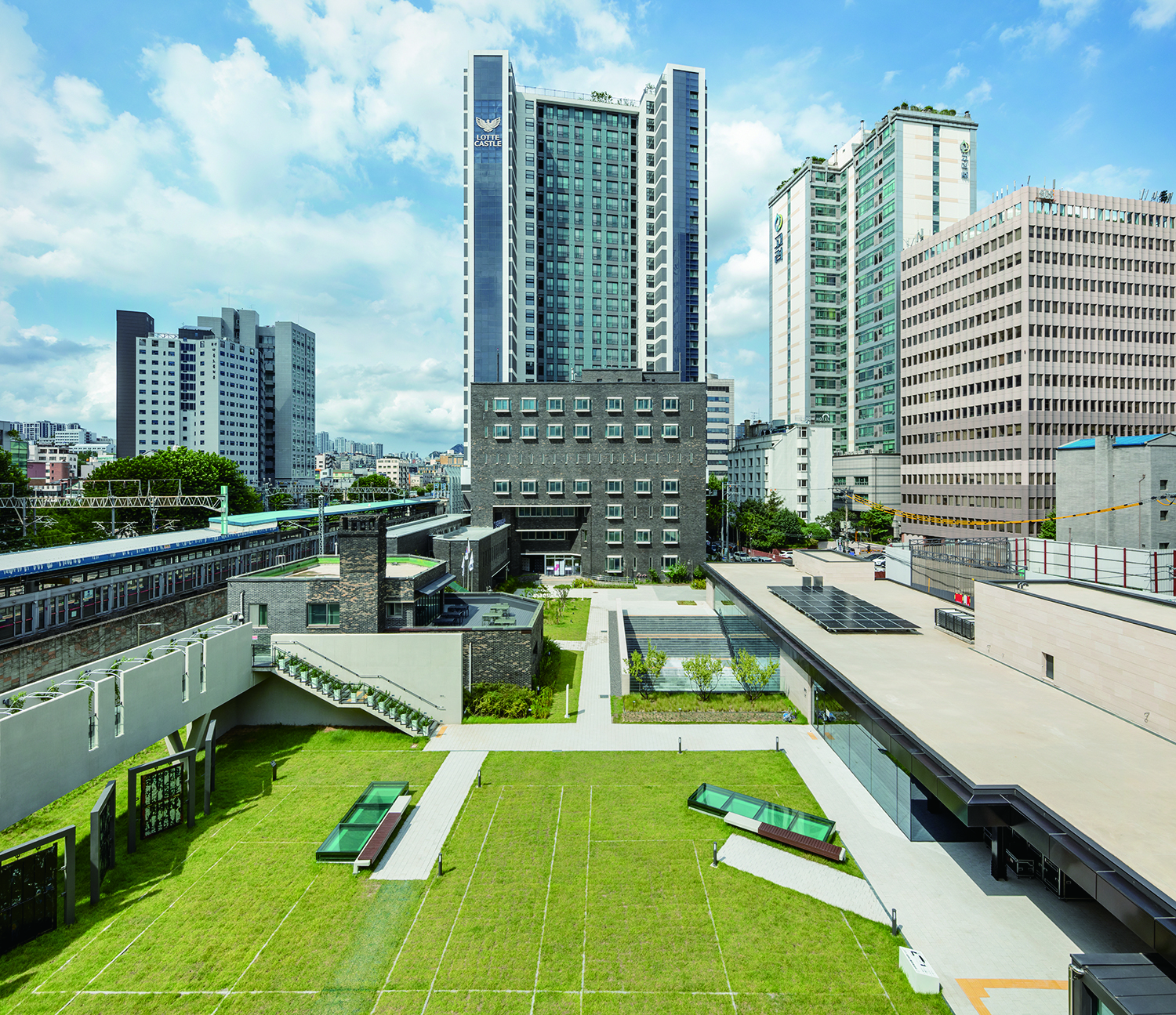
A view of the National Museum of Korean Democracy from the E (Education Building). As the surrounding area has been developed, the building is now surrounded by high-rise structures. Different textures and colours of materials have been used to distinguish between the historical and contemporary spaces.
Bang Yukyung: What was the reason for choosing sound as the medium of the exhibition?
Kim Youngchul: Among roughly 900,000 archival materials held by KDF, most were paper materials such as letters, documents, and photographs. I judged that with these contents, it would be difficult to hold the public’s gaze for long. In the democratisation movement, auditory content such as movement songs and slogans is as important as visual content. The fear that victims felt inside the dark investigation rooms was informed by sound. In order to allow people to experience the Anti-Communist Interrogation Office with a sense of being on site through sound as the medium, we installed 204 speakers throughout the building. We built a three-dimensional sound system in which sounds such as gunshots, the sounds of demonstrators, and impact sounds from suppressive activities collide in the upper floors and resonate throughout the entire building.
Bang Yukyung: In the case of the Anti-Communist Interrogation Office, there must also have been much consideration about ways of showing the acts of torture on the site.
Kim Youngchul: From the early planning stage, I met many experts and sought advice on the exhibition content. Since the dominant opinion was that ‘torture must not be depicted and cannot be depicted,’ we planned a direction that would not directly show the acts or situations of torture. However, the victims’ position was that the harsh scenes of torture had to be conveyed as they were. Since the exhibition space is the actual site where the incidents occurred, we focused on conveying the victims’ senses and the structure of state violence rather than on the sensational reproduction of violence.
Bang Yukyung: Unlike the Anti-Communist Interrogation Office, the M1 exhibition seems to have required another strategy. What did you want to show, and how?
Kim Youngchul: The exhibition was composed so that it would gradually expand and intersect across four broad areas: starting from the specific incident called the democratisation movement, then state violence, democracy, human rights and their imperatives, and the global democracy and human rights network. As recent museum exhibitions in Korea and abroad emphasise synesthetic experience and diversify toward participatory exhibitions and programmes, the M1 exhibition considered the architect’s intention and looked for ways to actively use the Main Hall. Accordingly, rather than a method of hanging works on the wall, we imagined a scene in which content gathers toward the centre, installed a media wall on the wall, and left the central space empty.
Chung Hyuna: I, too, imagined and designed an interactive exhibition in the M1. If it is an exhibition on democracy, I thought people should not observe passively, but rather visitors should participate in the exhibition themselves and interact together. Reflecting this, the initial concept for the underground Main Hall was to remove the distinction between the exhibit, or stage, and the audience. So in the Main Hall, I expected media to illuminate the floor or the viewers rather than the wall, but in reality, a media wall was installed on the wall surface, and the centre remained as a flexible space.
Kim Youngchul: In the early planning stage, we planned to project images across the entire Main Hall and wall surfaces and to place a flexible stage in the middle. However, since the floor of the exhibition room was finished in brick, this was not easy to implement. As the stage installation also became impossible because of budget issues, we instead installed performance lighting on the columns supporting the Main Hall. Since the site of the democratisation movement has the activity of a performance, if this infrastructure is used well, performances in forms such as musicals or plays could also be realised.
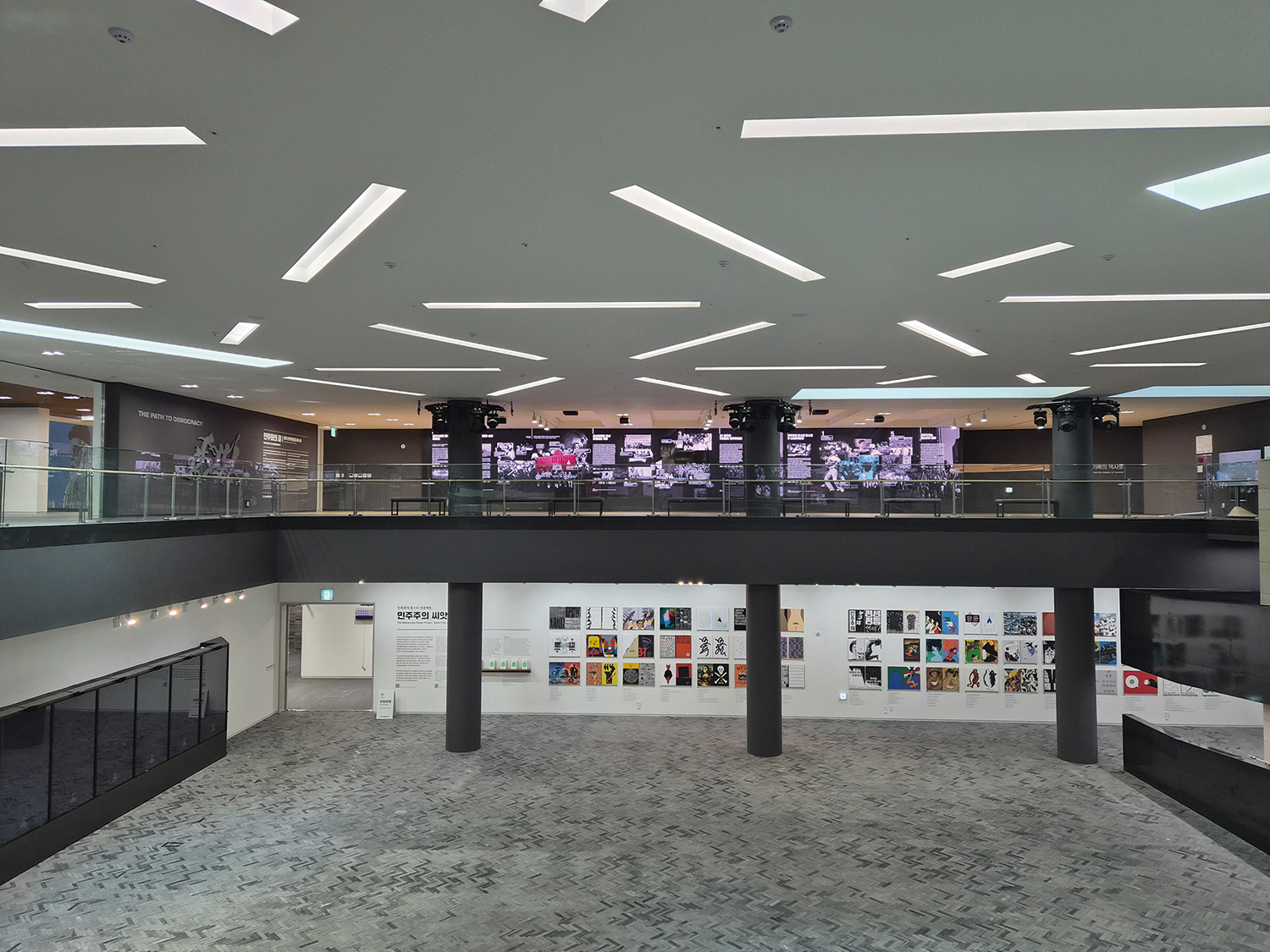
A view of the empty Main Hall in the M1, which spans the first and second basement levels. The M1 hosts both permanent and special exhibitions displayed on a media wall. ©Bang Yukyung
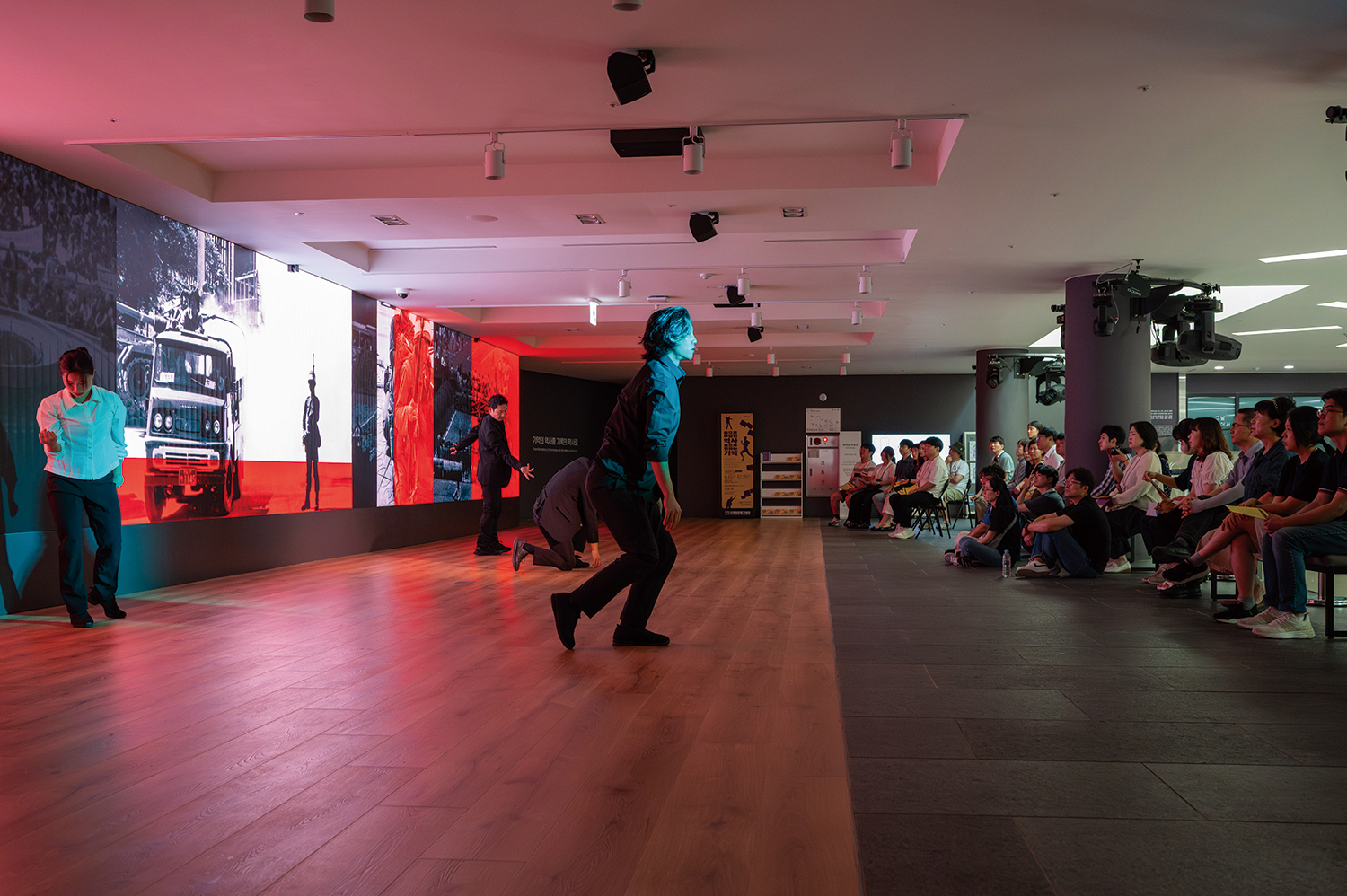
The Special Docent programme held in front of the media wall on the first basement level of the M1. Image courtesy of Korea Democracy Foundation
Bang Yukyung: The Special Docent programme seems to be a suitable example of this.
Kim Sungil: For one year after opening, we presented a docent programme in the form of a performance, in which performers who majored in dance expressed the content of the permanent exhibition through the body. It was held in front of the media wall on the first basement level of the M1, and when the Special Docent programme began, the existing exhibition screens, which had been divided by panel, turned off and changed into a single screen dealing with the history of the democratisation movement.
Chung Hyuna: It was refreshing because it was a performance form combining theatre and dance. Personally, I feel that the space in front of the current media wall is too narrow for performing. If the location were moved to the Main Hall, the large staircase at the entrance of the exhibition room, or The Path to Healing, which is currently alienated from the viewing circulation, might offer a different experience.
Kim Youngchul: While preparing the exhibition, I considered it important that the stage and the audience must not be isolated. Through trained performers who can control the performance situation, it is also possible to try an approach in which the audience does not simply sit still and watch, but intervenes and participates. If this kind of content is continuously developed and attempted, I think it could become a performance suited to the purpose of the space.
Bang Yukyung: One year has passed since the opening. As a user and operator, what changes or difficulties have you felt?
Kim Sungil: I feel a striking difference in that visitors who experienced the December 3
Martial Law Declaration in 2024 experience this place not from the viewpoint of observers but from the viewpoint of the people concerned. Recently, the Ministry of Education has also been strengthening education on the history of the democratisation movement, and since our KDF is the place in South Korea that has organised related materials most systematically, I feel both pride and burden. Nevertheless, I am deeply concerned about the problem that 70 to 80 percent of visitors – because of the intense and solemn experience of the Anti-Communist Interrogation Office – feel relatively little emotion toward the new-buildings (M1, E) exhibitions or programmes. After seeing the red-tiled exhibition room that shows the acts of torture, and the investigation rooms where student Park Jongchul or Kim Geuntae, chair of Mincheongnyeon, and many other democratisation activists were interrogated, it is inevitable that visitors’ hearts become heavy. I hope they leave with optimistic expectations and hopes for the present and future, not only with the pain and wounds of history. But the biggest current task is finding a way to connect the severed psychological gap between the two exhibition spaces through imaginative exhibits and education.
Chung Hyuna: It remains regrettable that the need for educational space was not conveyed during the design process. How are the current education programmes being conducted?
Kim Sungil: We are carrying out field learning for elementary school students, career-experience education for middle and high school students, family programmes, and lectures for the general public. Recently, we have also been operating education programmes for people with disabilities, where we, for example, conduct the programme in sign language or allow people to touch models, and participants are responding well.
Kim Youngchul: Such programmes are important, but I would like to propose that this place discuss not the past but current issues. If distinguished scholars were invited to hold lectures or discussions on things currently happening, such as the U.S.‒Iran war or the Russia‒Ukraine war, there would be an impact and ripple effect no less than that of an exhibition.
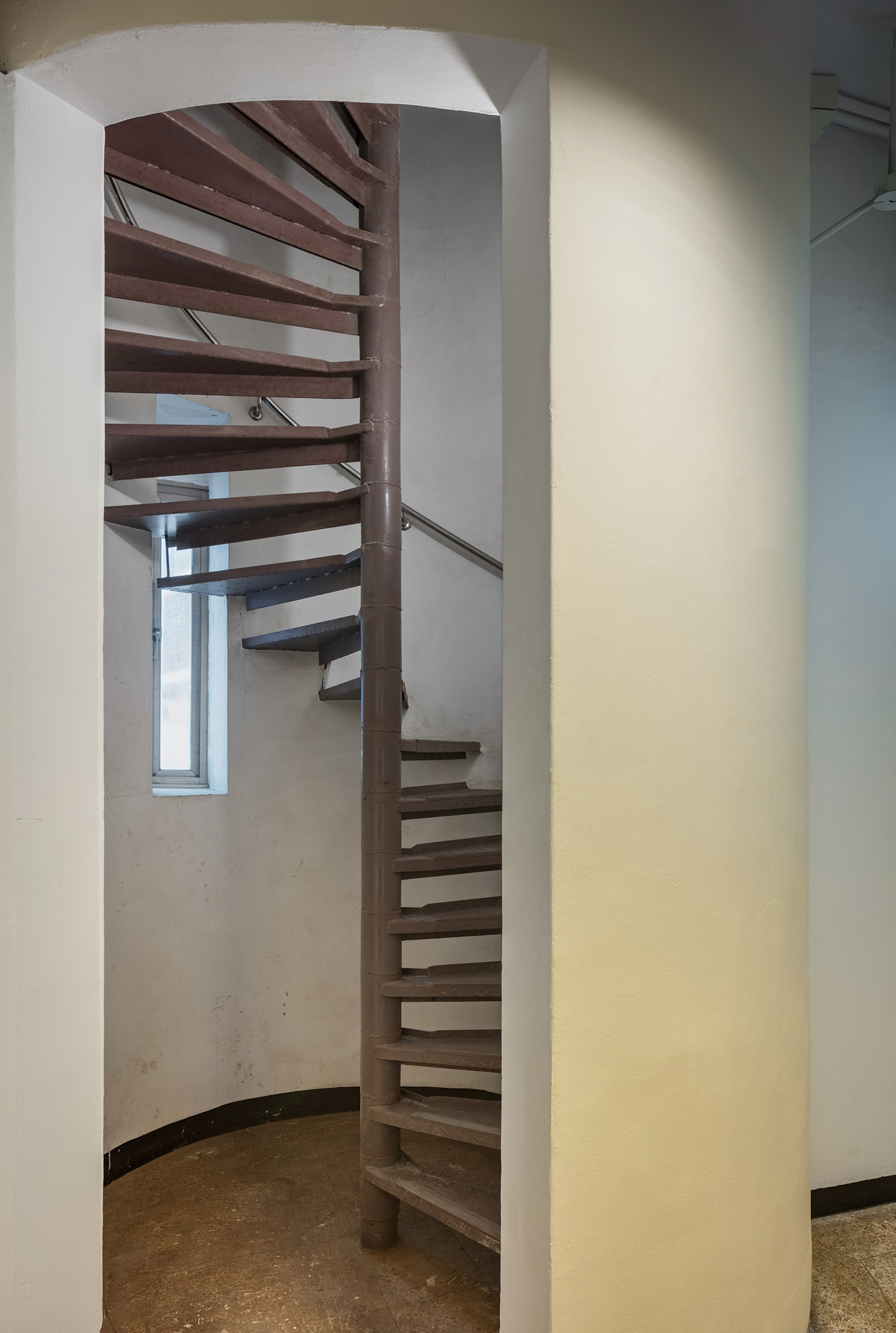
Detainees used the circular staircase inside the Namyeong-dong Anti-Communist Interrogation Office to move from the rear service entrance at the back of the building up to the investigation rooms on the fifth floor. It was designed in a circular shape so that one could not tell which floor one was on.
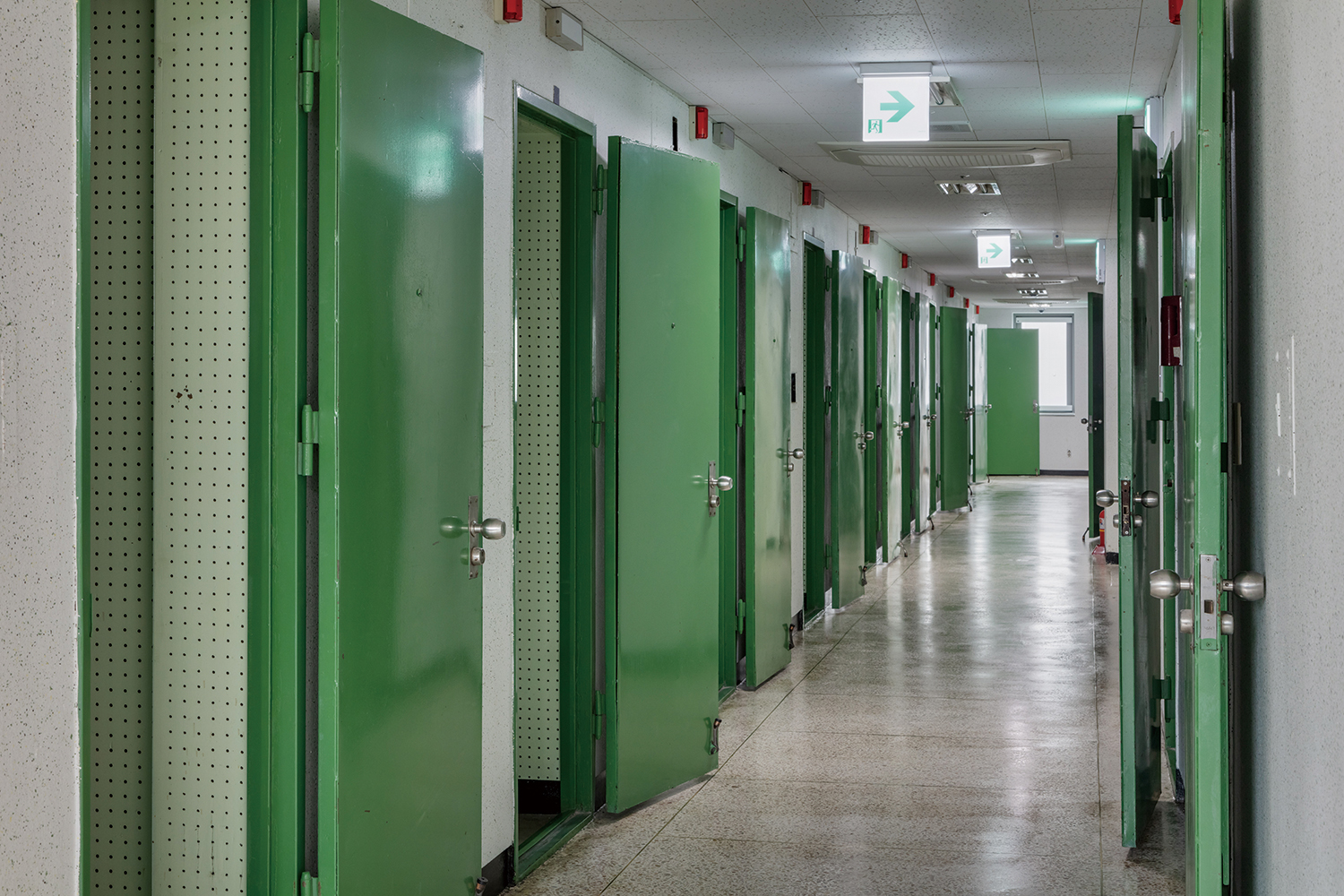
The corridor of the fifth-floor investigation rooms; the entrances were staggered so that the opposite rooms remained hidden from view even when the doors were opened.
Bang Yukyung: As the only national facility commemorating the democratisation movement, I felt its distinction in that it studies and exhibits not only events at a specific point in time but the entire history of the democratisation movement. How is the current democratisation movement archive being carried out?
Kim Sungil: We are collecting and archiving historical materials from the April 19 Revolution in 1960 to the June 10 Democratic Struggle in 1987. Because 1987, when the direct presidential election system was revived through constitutional amendment, is regarded as the point at which ‘democratisation became institutionally settled,’ we are collecting some related materials after that, but it is not easy to bring them fully to the forefront. However, with the current government’s request for the collection and research of materials on citizens’ movements to overcome the December 3
Insurrection providing an opportunity, we plan to study citizens’ movements after 1987 and establish comprehensive classification standards. As the title of Professor Choi Jang-Jip’s book Democracy after Democratisation: The Korean Experience suggests, the democratisation movement has branched into various movements expanding basic rights, such as human rights movements, gender equality movements, environmental movements, and movements to abolish discrimination against people with disabilities, so I expect the democratisation movement archive may come to have an expansiveness that encompasses all of these branches.
Kim Youngchul: The temporal concept just explained is applied to the current exhibition as it is. The permanent exhibition in the M1 also deals only with the anti-dictatorship struggle from 1960 to 1987, and records after the establishment of the civilian government in 1993 were not included in the exhibition content. In the exhibition, the concept of democracy is expressed as democratisation, but even if democratisation is considered to have ended, democracy itself is still an ongoing present, is it not? These concepts should be expanded into content such as exhibitions and education, and should retain contemporaneity.
Chung Hyuna: In that sense, the name used at the time of the design competition, Democracy and Human Rights Memorial Hall, seems to have more contemporaneity and determinacy than National Museum of Korean Democracy. Although the name was changed because of a point made during the Inspection of State Affairs that it should follow KDF’s legal basis, it would be good if the previous name could be recovered so that it could embrace the present and future as well.
Kim Sungil: We also view the themes just discussed as our work. The goal of KDF is how to expand the democratisation movement into democracy in everyday life. The people who led the democratisation movement were not extraordinarily special people, but ordinary people who had hearts that could not look away when they saw the pain of others. Like the character in Han Kang’s novel Human Acts, when asked ‘why did you stay at the Provincial Office,’ answering, ‘because I felt I had to.’ I think our role is to make people realise that democracy in everyday life also begins from the act of looking closely at oneself and at one’s surroundings.
Kim Youngchul: Now democracy is operating formally and institutionally, but conversely, we are living a very controlled everyday life. The more that is the case, the more important each individual’s autonomous judgment will become.
I expect that from now on, there will not again be a dramatic democratisation movement like those of the 1960s to 1980s. Nevertheless, just as changes in social awareness occurred through the December 3 Insurrection, we must develop content that can convey the ideology of democracy based on autonomy.
Bang Yukyung: It seems that the National Museum of Korean Democracy has reached a stage where it must also consider its future meaning. Lastly, I would like to hear each of your reflections.
Chung Hyuna: When designing leisure facilities such as resorts or hotels, one’s heart becomes joyful and relaxed because one is imagining pleasant things, but with this project, my heart remained heavy from beginning to end as I designed it. I hope that through this space, even a little comfort and support can be given to those who have long suffered psychological pain. In addition, in the Yongsan area, where the scenery is changing as high-rise buildings emerge,
I hope it will become established as a public place that serves as an urban park that people enjoy visiting.
Kim Youngchul: It must become a diverse space in keeping with the contemporary era and where various activities and events take place, not only a space for the memory of the past democratisation movement. There are very many functions hidden inside the museum, and it would be great if the space became alive with people gradually discovering what the museum has to offer.
Kim Sungil: Through this conversation, I came to return to the initial intention and think again about the process of planning the museum and the value and meaning of the work we do. I intend to more actively seek ways for people to experience not only pain here, but also contemplation and healing. I thank the three of you for giving us meaningful matters to consider.
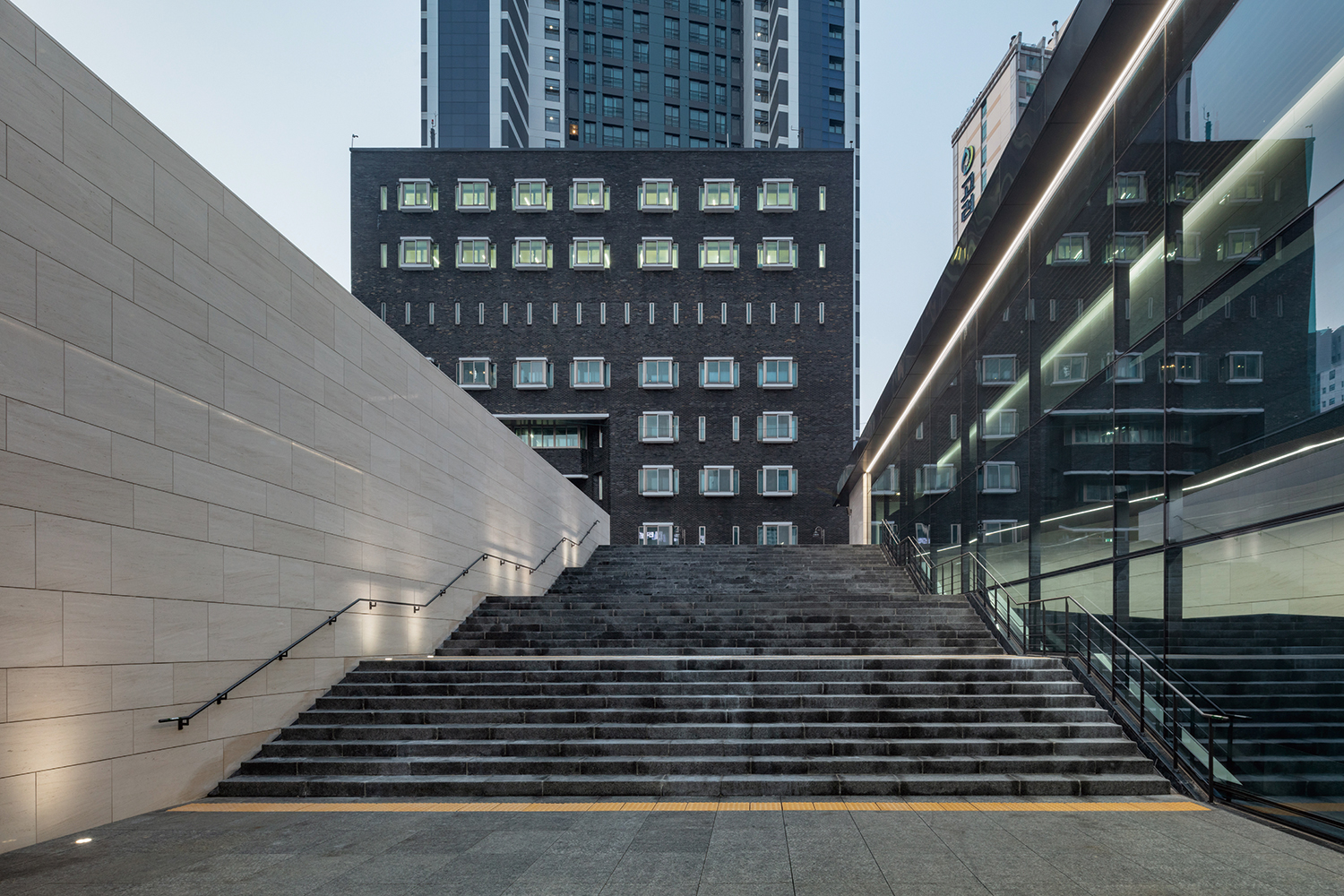
The M2 as seen from the grand outdoor staircase leading down to the basement level of the M1. Currently, only the first five floors are used as exhibition spaces, whilst the sixth and seventh floors are used as offices.
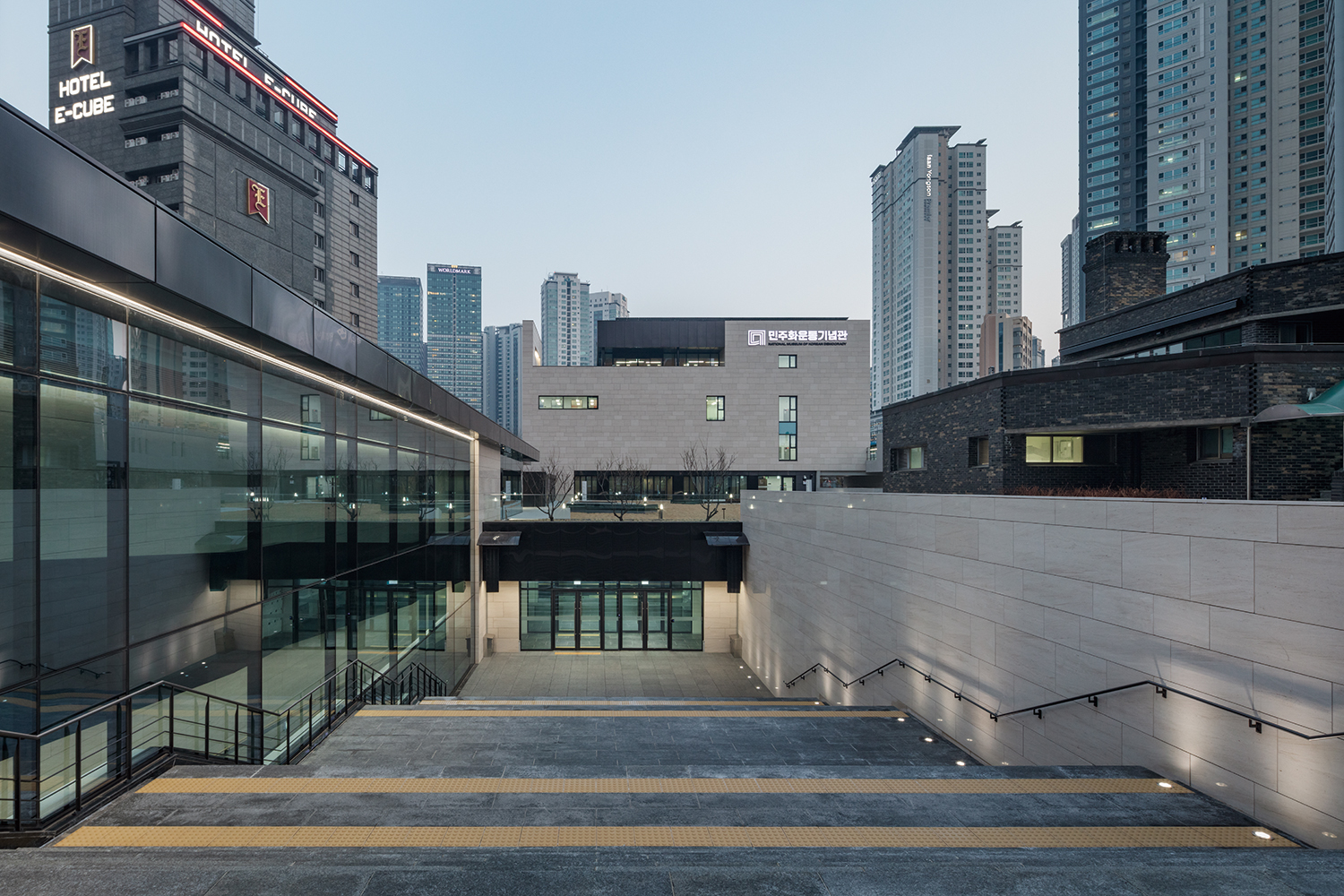
A view of the E and M1 as seen from the front of the M2