SPACE February 2026 (No. 699)
Yeoncheon
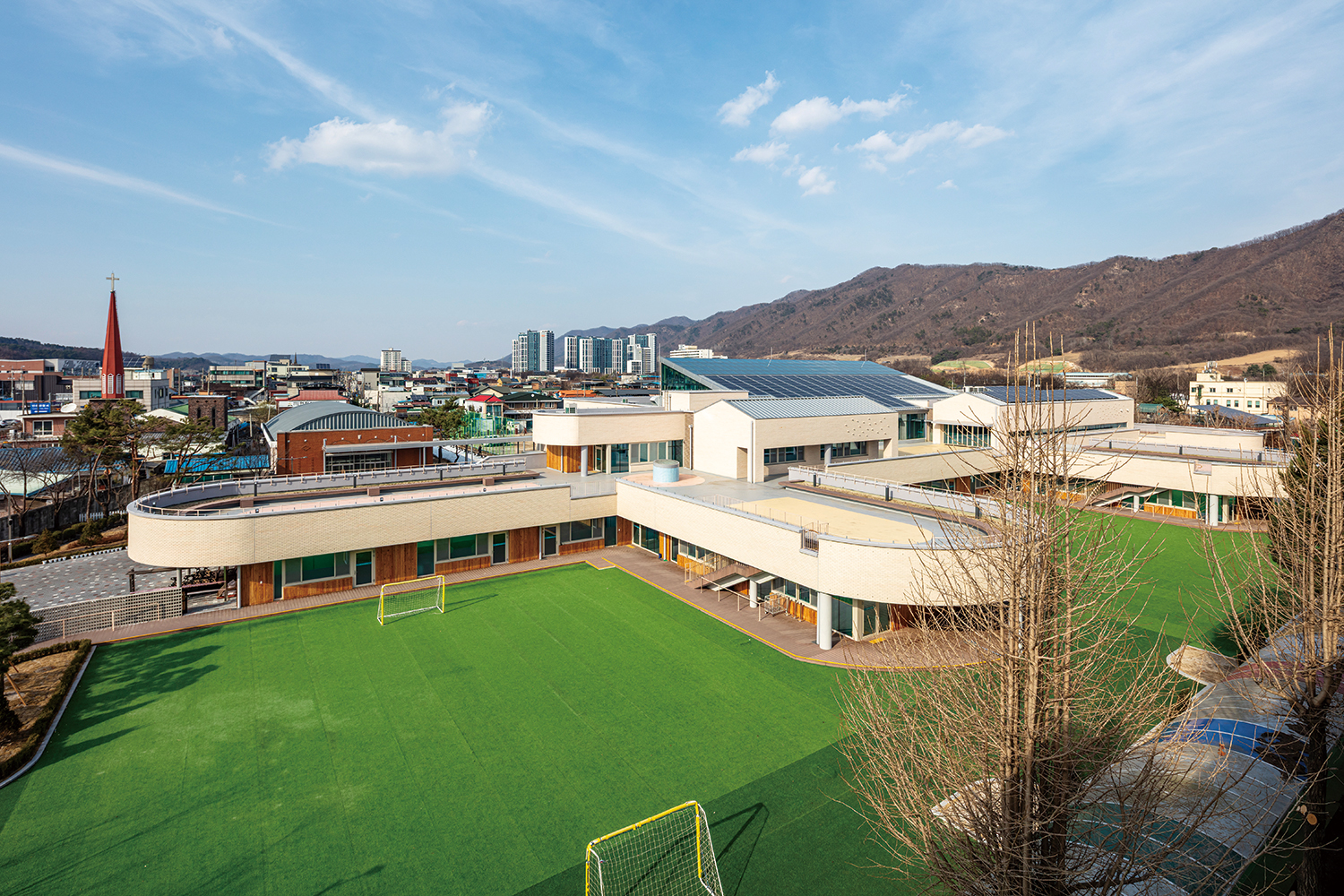
Yeoncheon-gun is located at the northernmost part of Gyeonggi-do. It is a remote place, relatively inaccessible from the metropolitan area. Yet this distance has preserved Yeoncheon-gun’s ecological environment, resulting in a beautiful and unique landscape. Yeoncheon Elementary School, located at Yeoncheon-eup, is a public school with a history of over 110 years. For a long time, it maintained the appearance of typical school architecture, built according to standardised plans of the past. Classrooms were arranged in a single linear corridor, forming a unidirectional spatial structure, while the openness of the playground gave a strong impression. With the student population steadily declining to around 210, and with the aging of the building, ʻSpace Innovation Reconstruction of Yeoncheon Elementary School’ project was approved, involving the demolition and rebuilding of all existing classroom buildings except the multipurpose hall, residence building, and garage.
Vision
The preliminary planning of the design competition suggested the school should have a flexible and open space with a rooftop garden, be a low-rise school, and embody the concept of a ‘UNESCO school’. These keywords naturally resonated with our previous works and offered an opportunity to refine and extend ideas that had previously remained incomplete. For Gonghang High School (2019), we hoped the atrium could accommodate more permanent, everyday programmes. At Singil Middle School (2021), we were unable to realise a sufficiently open central space where many students could gather. These experiences led us to focus more deliberately on the concept of an indoor plaza for Yeoncheon Elementary School.
The UNESCO School
When designing schools, we ask ourselves what kind of space will be committed to memory as the background to students’ memories of their school years. Yeoncheon Elementary School is a UNESCO school. An international school network was founded by UNESCO in 1953, with the aim of promoting ideas such as peace, freedom, justice, and human rights through diverse educational activities. In Korea, there are approximately 500 schools currently operating as UNESCO schools. They carry out comprehensive programmes such as cultural exchanges, local and environmental activities, human rights education, and public campaigns. However, there are few cases where these educational goals are directly linked to the physical space. We sought to embody the UNESCO school philosophy and the natural context of Yeoncheon within the school space, resulting in the proposal of a ‘wooden structured indoor plaza’.
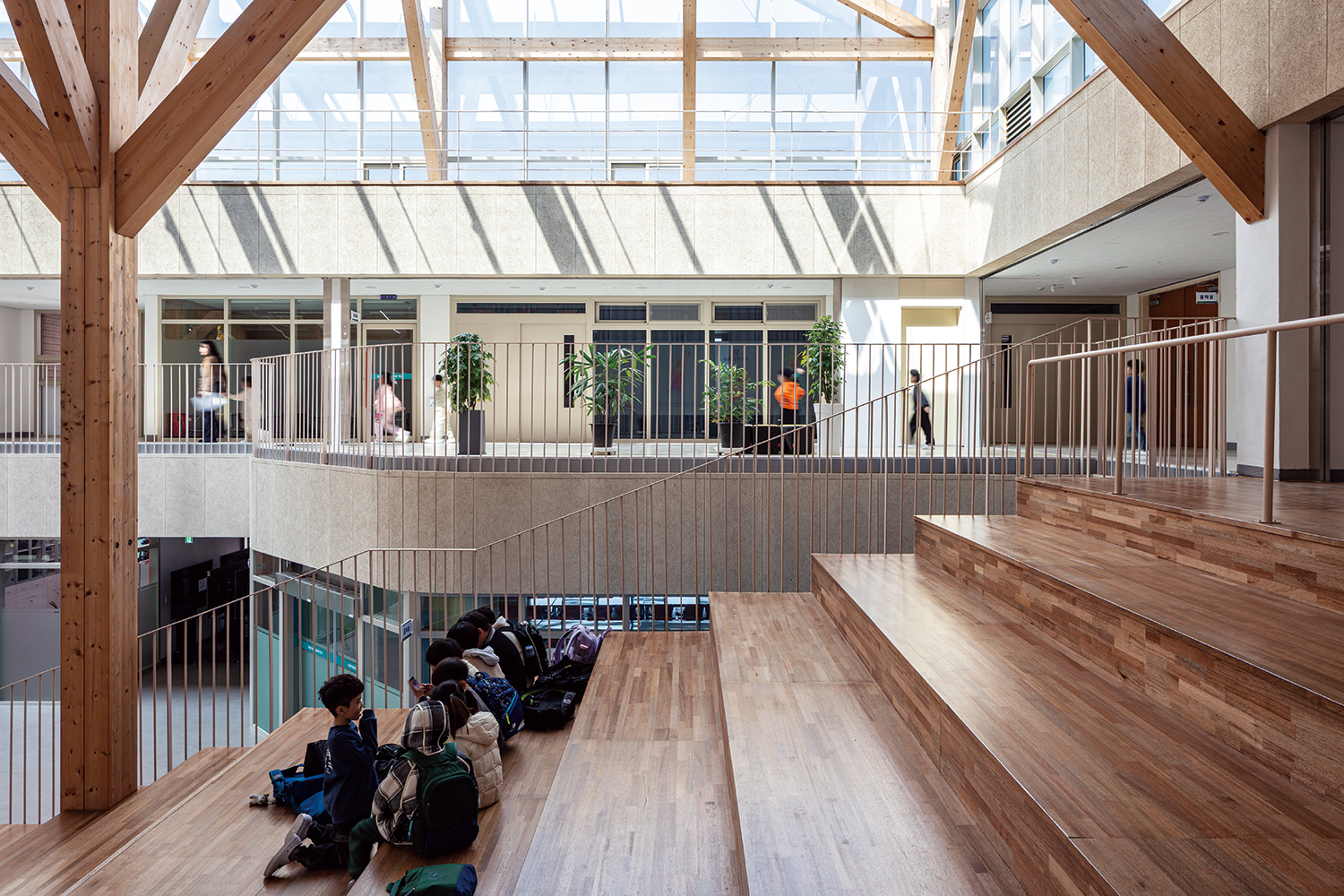
The Indoor Plaza
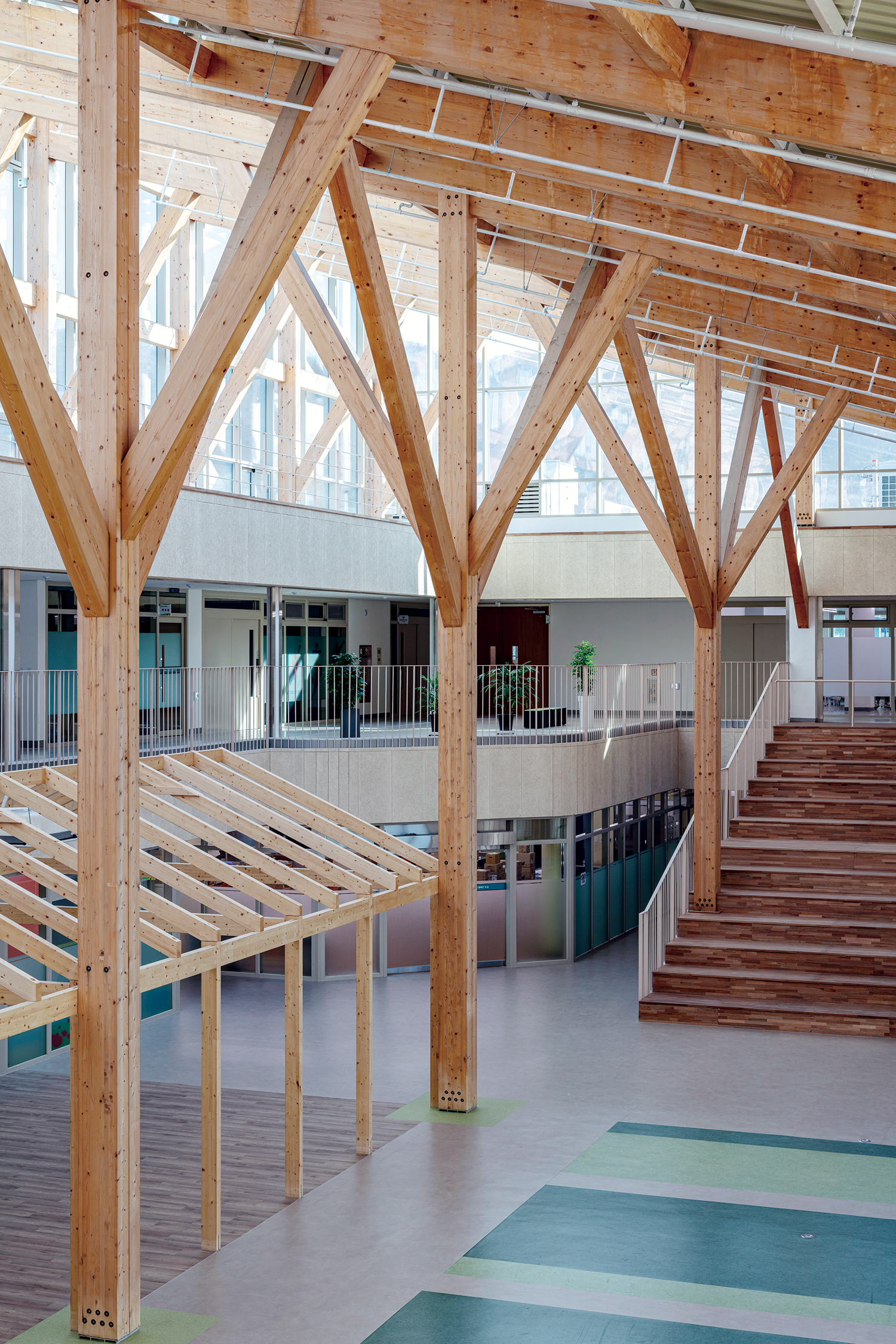
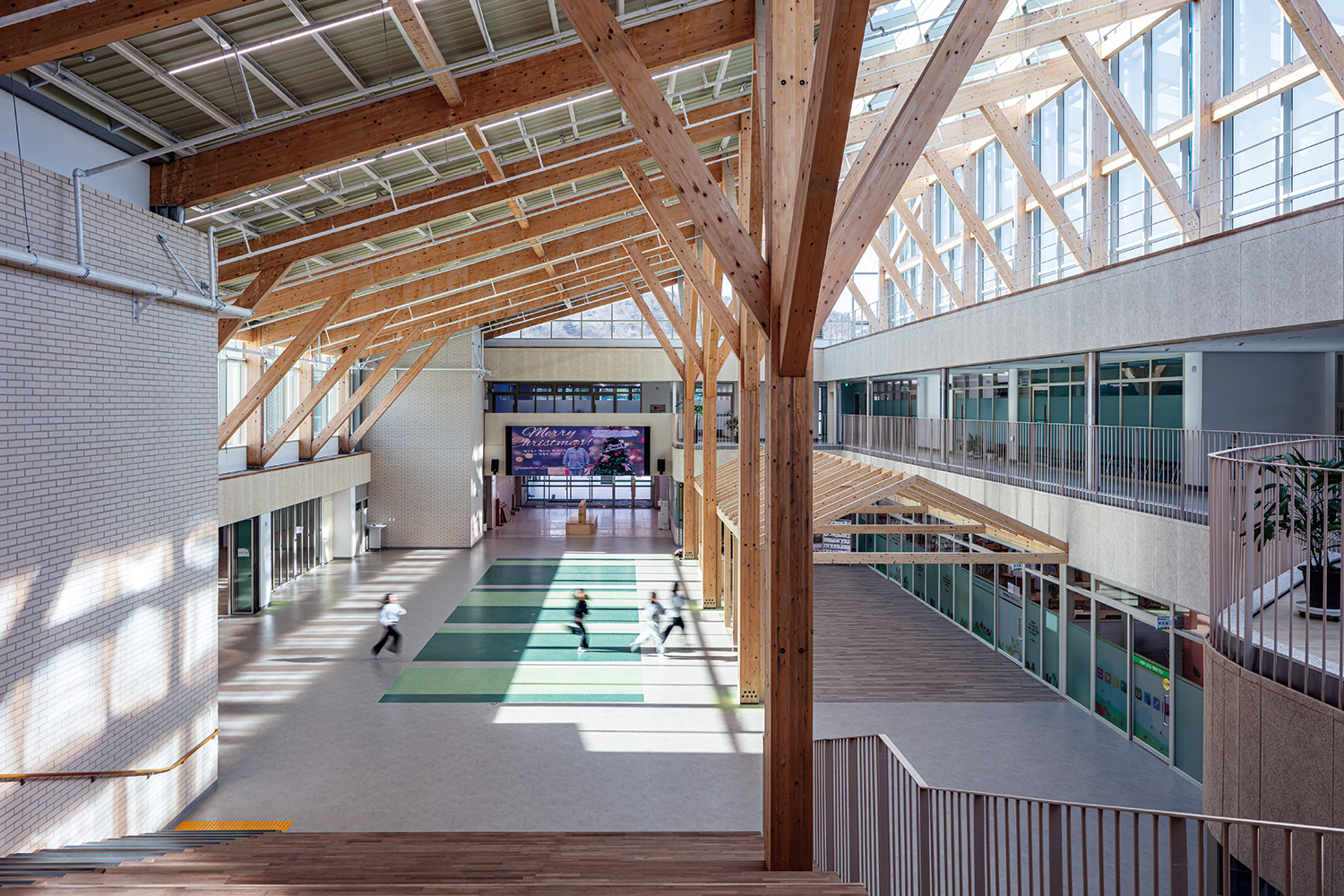
The goal of a UNESCO school is to cultivate students’ communication and empathy skills as global citizens. To achieve this, we designed a large indoor plaza ̵ ̵ similar to the Agora, the public plaza of ancient Greece ̵ ̵ where everyone can face each other, linger, and interact. Instead of entering through narrow staircases and long corridors, students are welcomed each morning into a tall, open indoor plaza filled with daylight filtering in through skylights. This space does not impose circulation or force students to move in a single direction. Instead, students move freely through the bright, wide space, making spontaneous and creative choices.
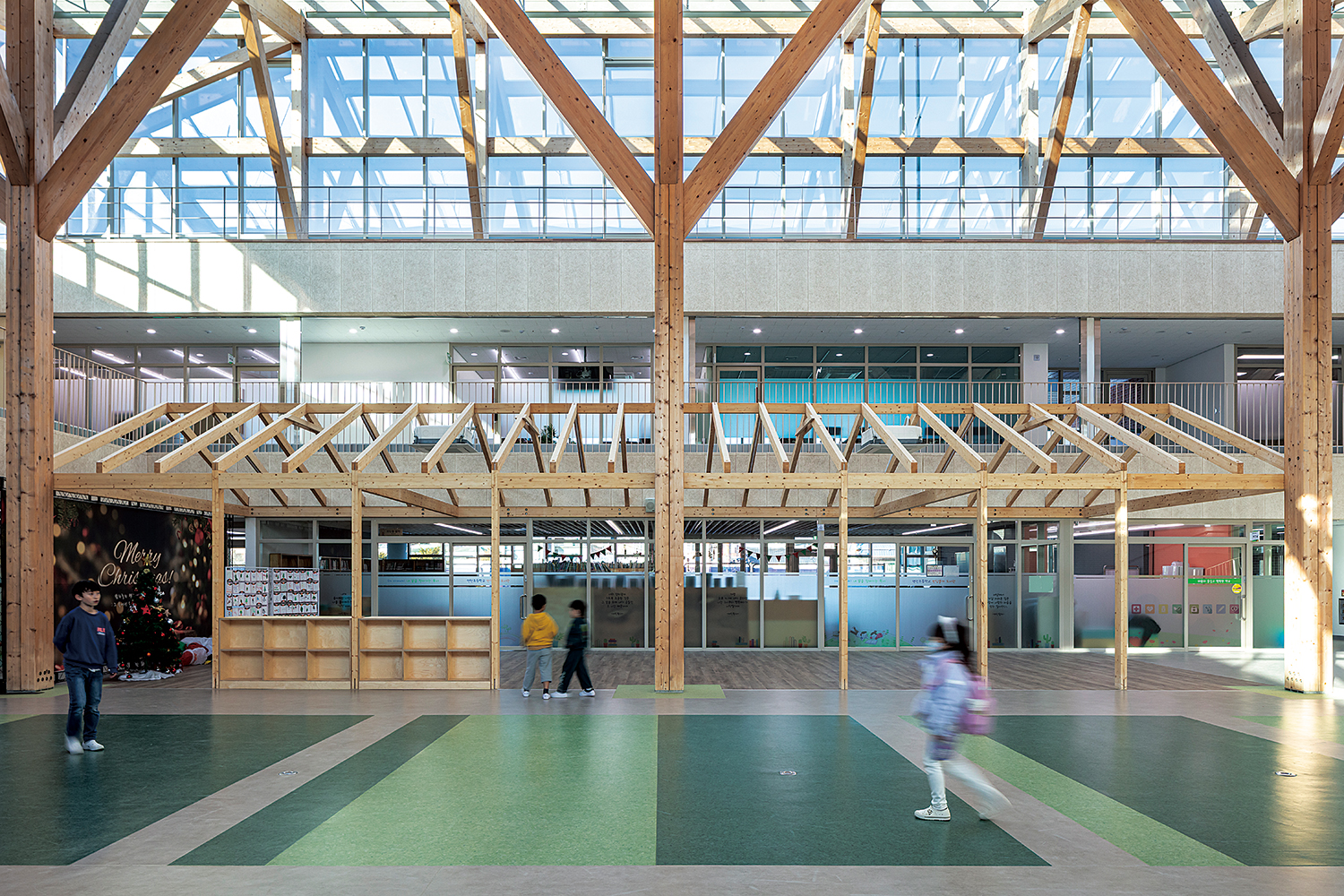
At one end of the plaza is a wide staircase where all students can sit, and in front of the library sits a house-shaped wooden pavilion which is installed to encourage interaction and play among students. The plaza hosts not only school events, but also a variety of programmes connected to the local community. When we visited the school after completion, a small festival was held during lunchtime. Some were hosts, others danced to K-pop music, while many sat on the steps laughing and chatting. It was impressive to see teachers leaning against the second-floor railings, watching students, which proved that the space was functioning as intended.
Wooden Structure
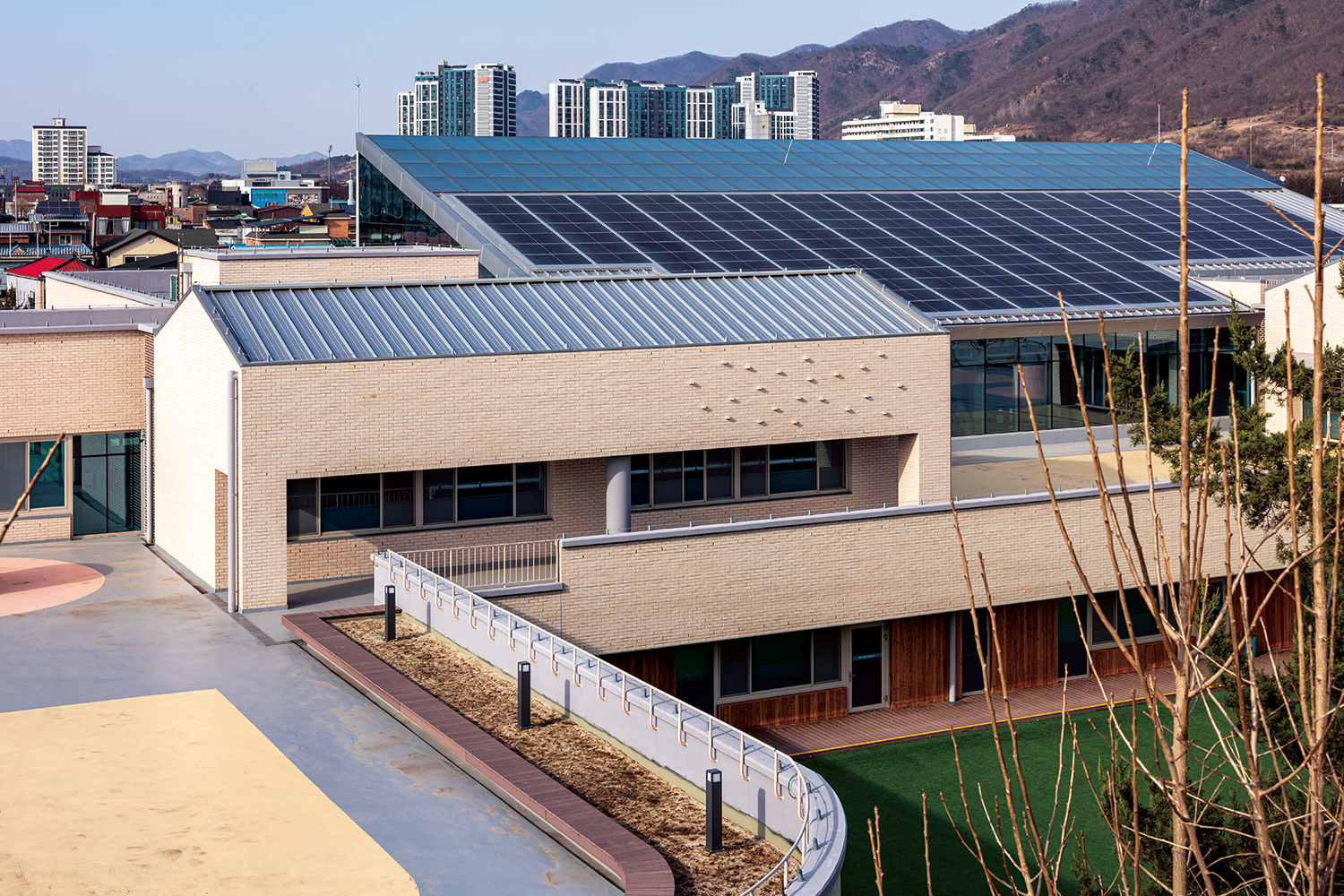
For the columns and roof beams of the indoor plaza, a wooden structure using glulam was applied. The vertical columns and the inclined columns extending upward to support the roof conjures the image of trees in a forest. Two-thirds of the south-facing sloped roof is fitted with BIPV, while the rest incorporates skylights, balancing renewable energy requirements with solar control. Some of the daylight entering through the skylights escapes through the curtain wall, while some is reflected and diffused back into the interior. The trajectory of light traversing the space and the shimmering reflected light on the walls provide a sensory experience for students. However, as wooden structure is rarely found in school architecture, there were several challenges during construction, and concerns regarding construction quality still remain.
Openness
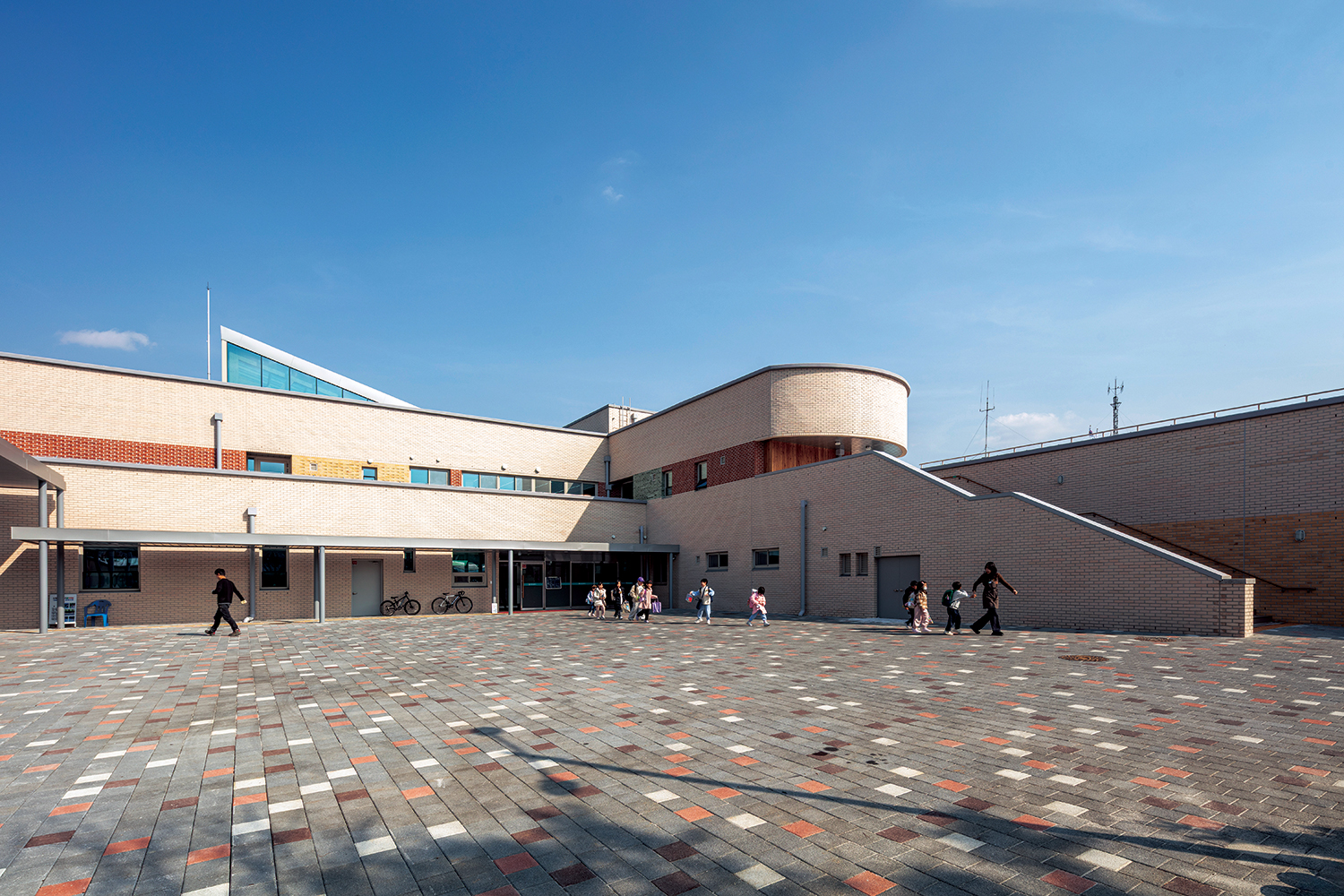
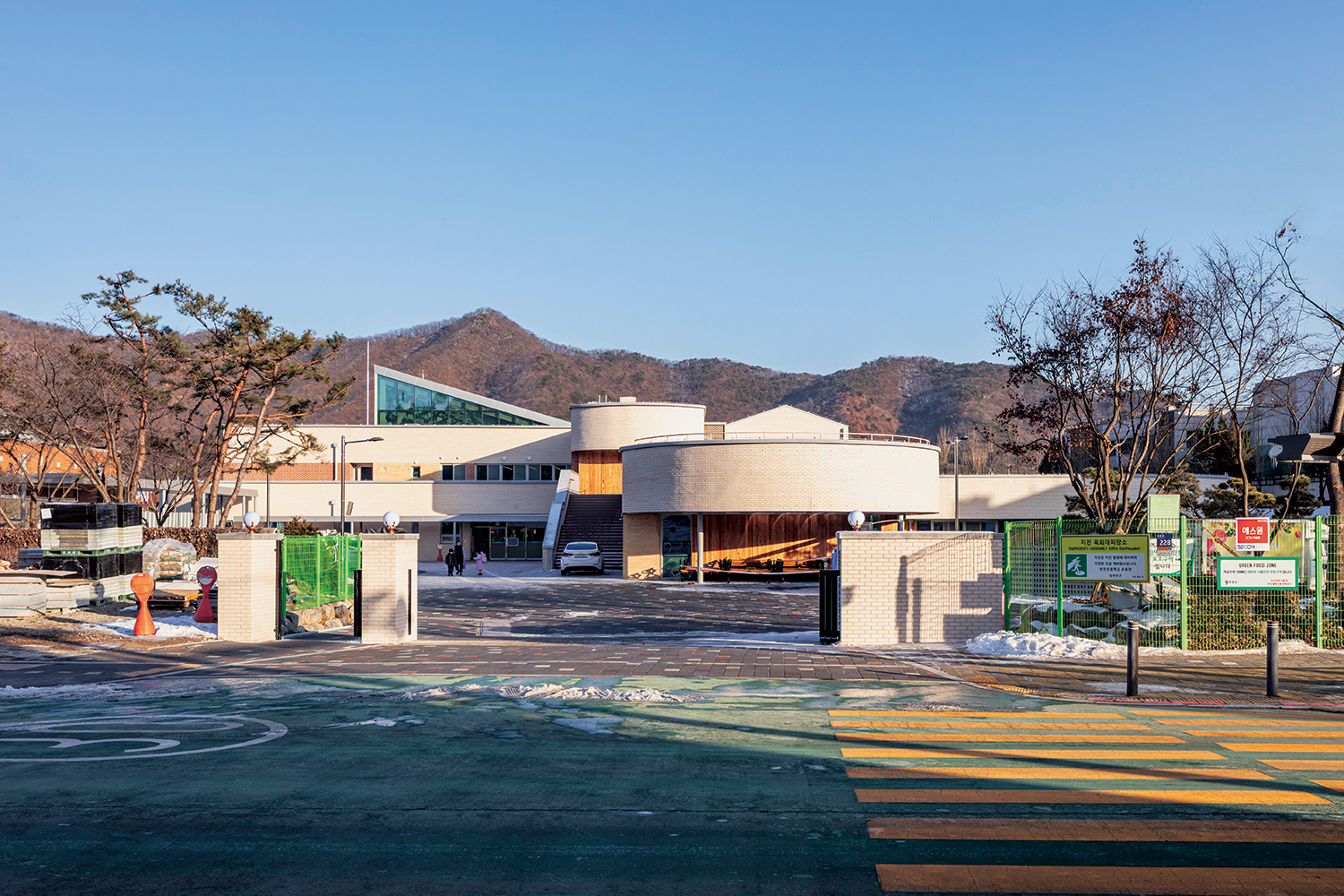
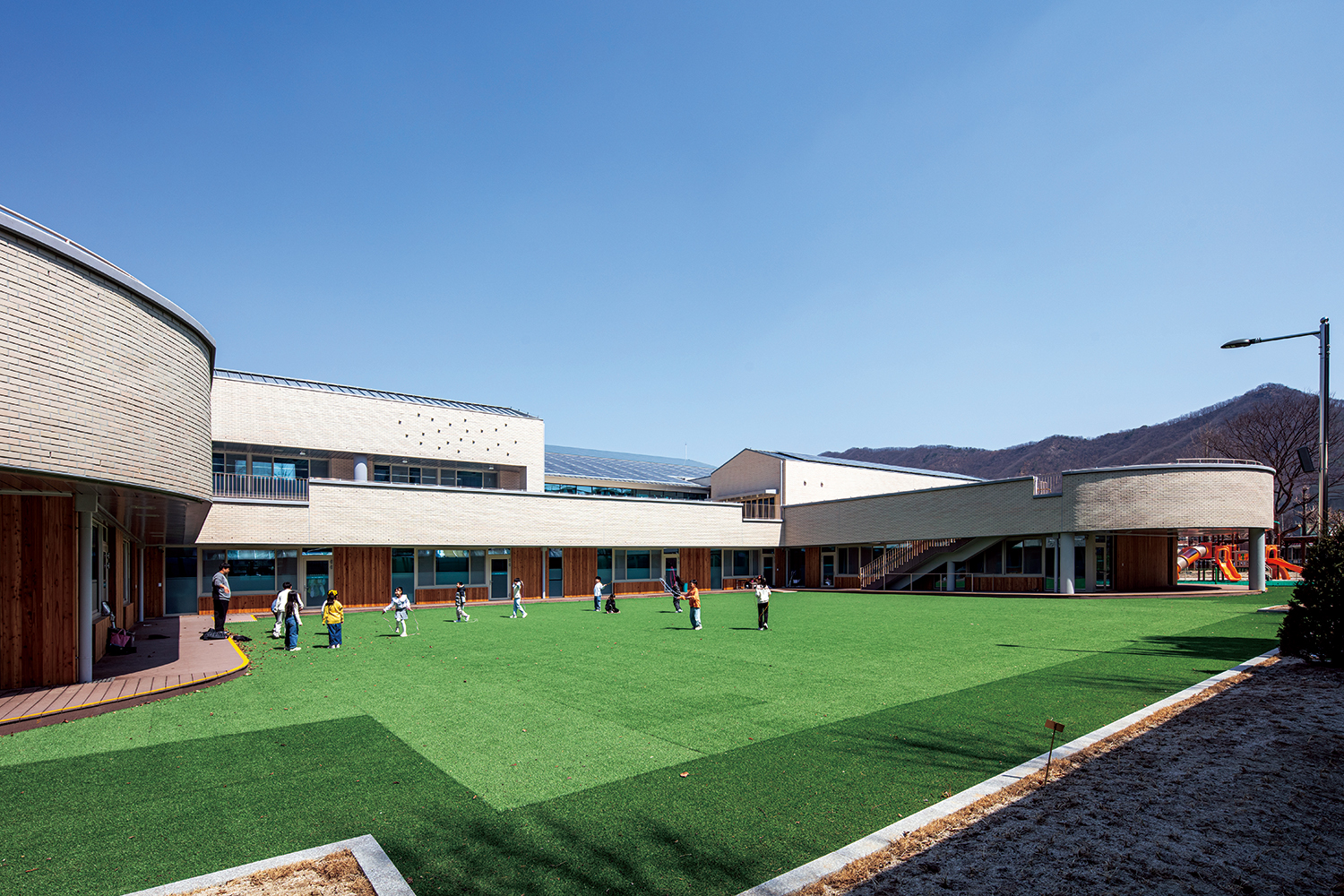
The indoor plaza is organically connected to and surrounded by the school’s major spaces, including classrooms, after-school care rooms, library, cafeteria, special classrooms, and administrative facilities. Classrooms on the south side were placed entirely on the first floor, except for two classrooms being added later. This layout was made possible by the relatively small number of classrooms and the expansive site. With classrooms directly connected to outdoor yards, students can easily step outside even during short breaks, which has positive effects on their emotional well-being.
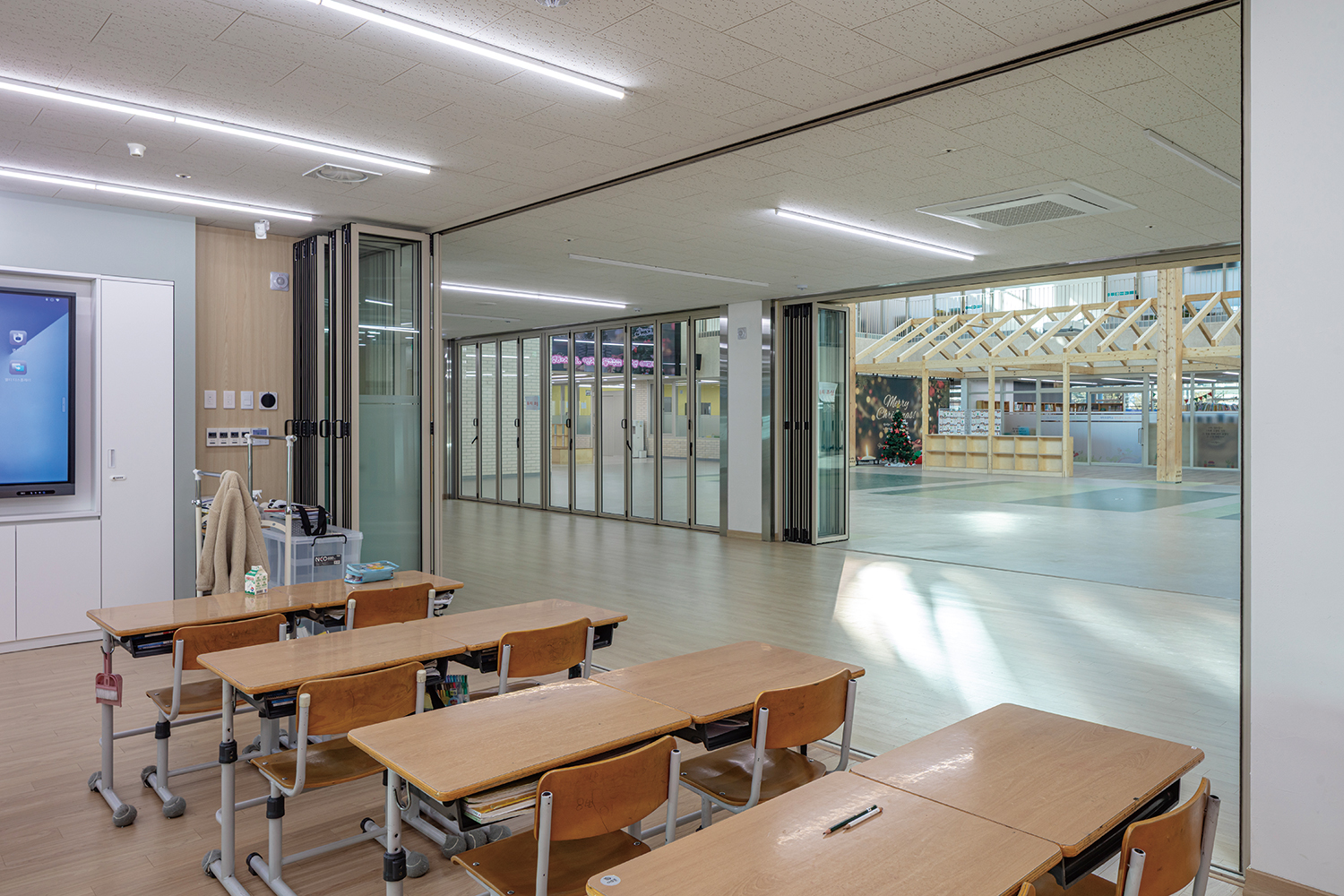
A cluster of classrooms are divided into lower grades, upper grades, and kindergarten. Each cluster has a common hall at its centre, with learning streets in between. While the learning spaces border the indoor plaza, noise and circulation routes can be managed by folding doors during events. Withing the circular layout, the outdoor yards are loosely partitioned according to grade level and usage, and internal rooms are designed to be linked with public areas like flexible open classrooms and the learning streets. Special classrooms and administrative facilities are located on the second floor, with staircases leading down to the ground-level yards.
Beyond Architecture
Yeoncheon Elementary School has one of the most well-equipped digital environments in Gyeonggi-do. It features AI-based classes, VR experiences, interactive whiteboards in every classroom, and individual tablets with digital education programs. The large digital monitor on the balcony wall at the indoor plaza is actively used for events and education. This is beyond the role of architects. It is an outcome of the cooperation between the school, the Office of Education, local governments, and the community. A good space does not guarantee a good school, and even a good space cannot be guaranteed by the architects alone. A great school space is created through the intertwined efforts of architects, school members, and sometimes even the interest and attitude of society, though the influence may be less obvious. Like all public buildings, school architecture is the collective result of a social community. I would like to express my gratitude to the faculty who are faithfully bringing the design intent to life.
2JIP Architects (Lee Hyunwoo)
Kim Taegyu, Son Sooman
Yeoncheon-ro 228, Yeoncheon-eup, Yeoncheon-gun, G
elementary school
17,959m²
4,831.97m²
6,532.91m²
B1, 2F
39
14.54m
26.9%
35.5%
RC, wooden structure
clay brick
medium-duty vinyl sheet flooring, semi-noncombust
YIGUN Structural Engineering Group, HWAN Engineer
SUYANG ENGINEERING
Dohye Total Construction
Mar. 2022 – Mar. 2023
May 2023 – Feb. 2025
22.5 billion KRW
Yeoncheon Office of Education
NAWOOGEO CONSULTANTS
Shinlim Landscape Architecture